Two announcements this week read like routine deal news. I think what they're really about is the one thing that every founder building on AI should understand.
What happened
On 20 Oct OpenAI said it acquired Orchestra Bio, a four year old startup whose AI agents help drug companies coordinate the work of developing a medicine. Its team is folding into OpenAI's own life sciences department.
Three days later Chroma said it signed an agreement to join Replit. Chroma makes a popular open source database that many AI apps use to find the right information. As part of the move it's shutting down its paid hosted service, Chroma Cloud. Customers can't add new data from 22 Nov, and can't read it from 22 Dec. The free open source version continues.
The idea: part of your roadmap isn't yours
If your product sits on someone else's platform, there are two things that can happen on their timeline rather than yours. The big player can move into your market. Or the service you're reliant on can change or go away.
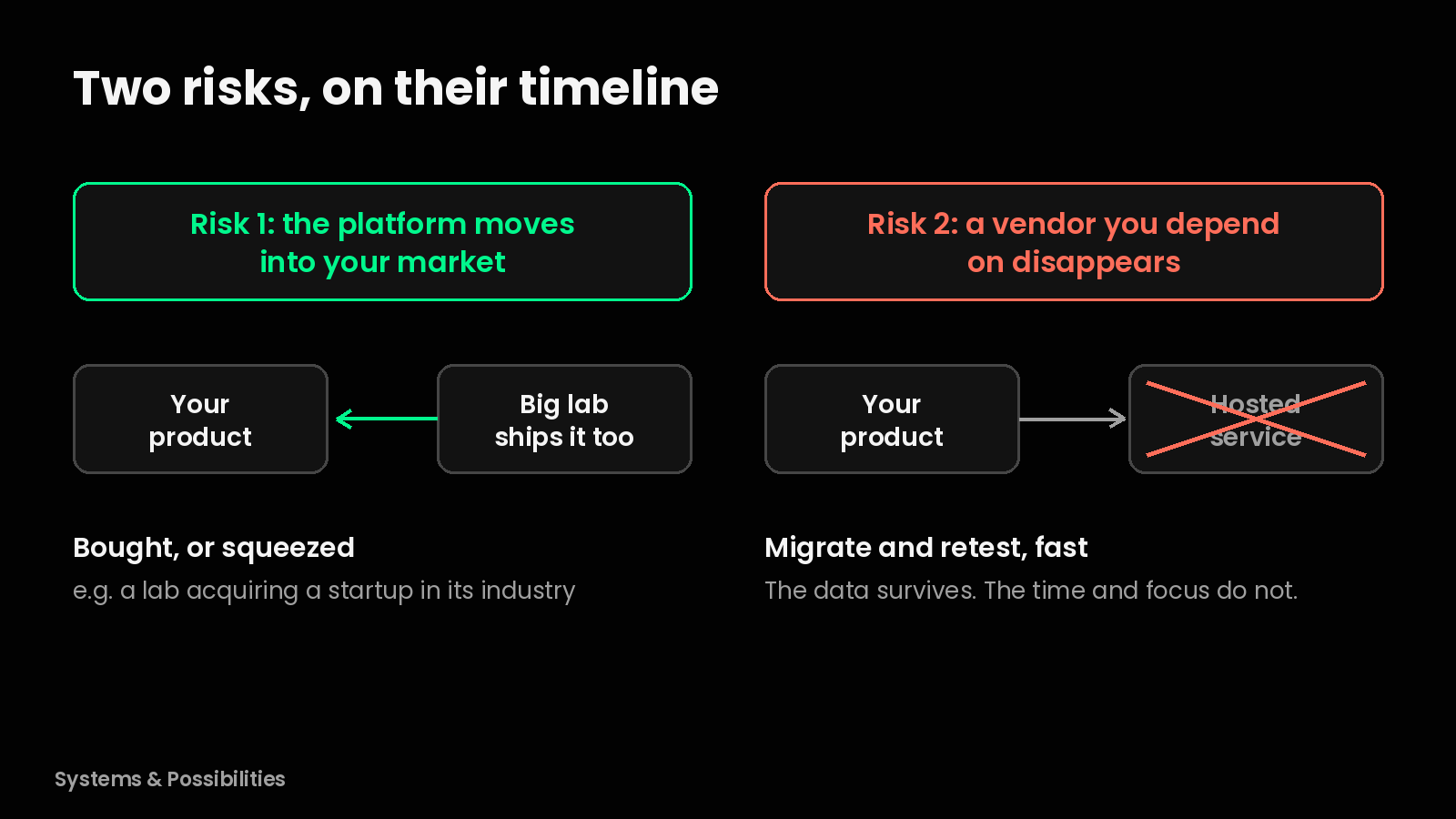
Two kinds of platform risk, both on someone else's timeline.
Why it happened
The big AI labs need revenue beyond chat, so they move into industries where startups already make money. Sometimes they build, sometimes they buy.
For a founder like the one at Orchestra, is that good news? Being absorbed by a lab is the happy ending and the dream for most founders. But it depends on what the founder really wants. If the founder wants an early exit to move to the next big thing, or to just chill and enjoy life, then being absorbed by a big lab is the best thing that can happen.
But the founders who are passionate about the idea and want to run it themselves get stuck with a competitor who has endless resources. But I feel it doesn't always mean they can't thrive. I feel distribution matters way more. For a startup, its customers are the whole game, whereas for a big lab they're just one market out of many. So those who understand the customers and win distribution can survive against huge AI labs.
Big companies moving into their partners' markets isn't new either. It's as old as time. Apple made its own versions of famous apps, Amazon created its own branded versions of famous products, and Facebook tried to replicate or buy its competitors. There's even a word for it. In 2002 Apple's Sherlock 3 copied a popular app called Watson, which was discontinued two years later. Developers still call it getting "Sherlocked".
But big doesn't always win. Take Amazon for example. It has tried to buy many startups and to have its stake in every major technology. Take its Kiro AI coding assistant. How many of us have actually heard about it? Having a stake in every major domain is one thing, but actually being able to capture the market is totally different.
Or take Facebook vs Snapchat. Facebook bought Instagram and WhatsApp but couldn't buy Snapchat. So it tried to replicate Snapchat's features in its own products. But Snapchat never lost its core customer base and still kept growing.
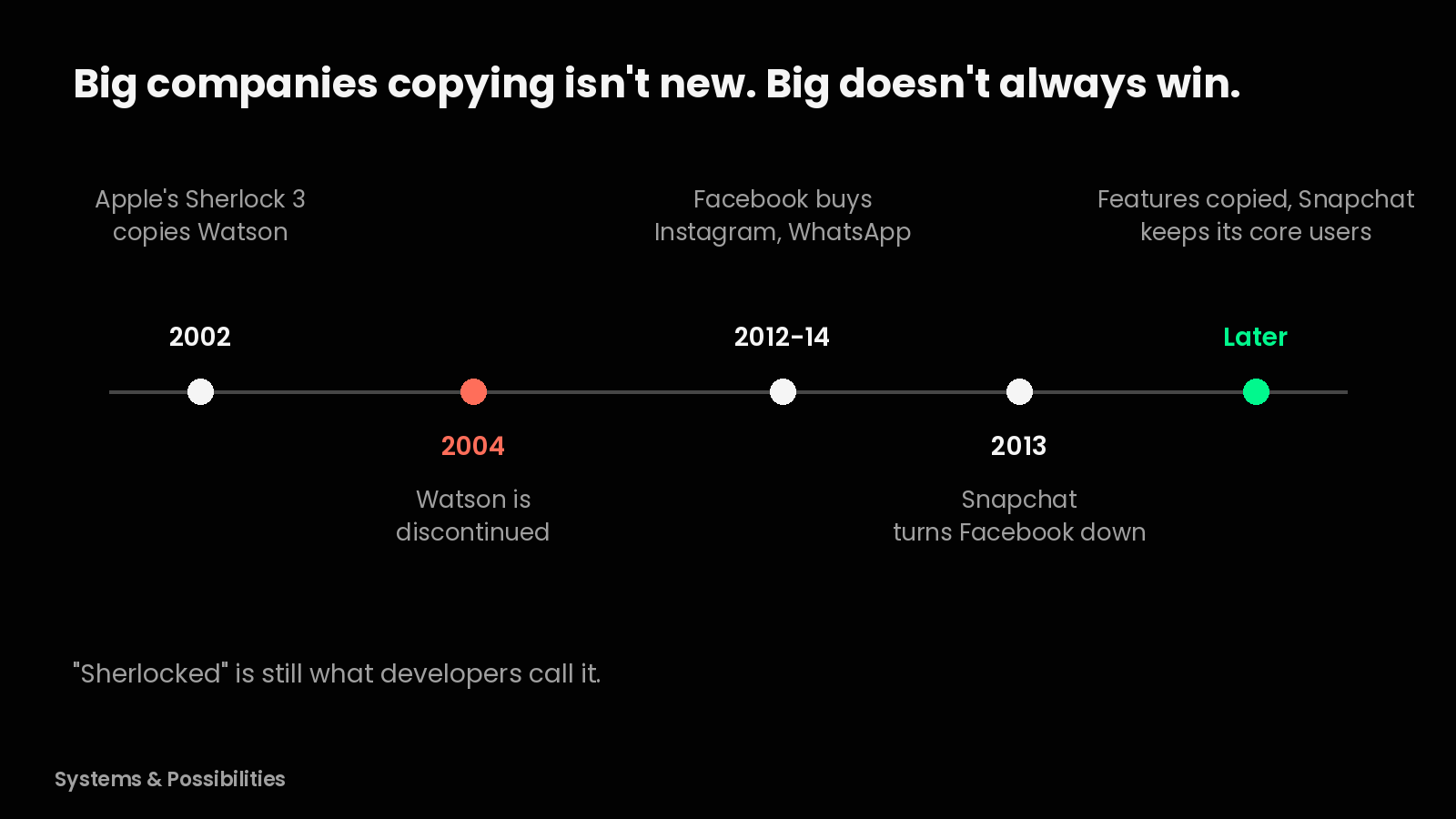
Copying is old. Winning isn't guaranteed.
The system: what actually protects you
First, stop worrying about the "wrapper" label. Meh. All software is a wrapper of something else. The value is in understanding the customer, making the product cater to their needs, and the distribution.
All startups do get better when the model improves, but if the provider ships a feature which is the core of a startup's product, the startup will see a loss in revenue. The strange thing is many products that looked safe got absorbed, and some that looked thin survived on distribution. I have seen many wrappers that just provide a refined prompt and still survive.
You can see this with slides. Now LLM providers can make PPTs. Claude and ChatGPT both create decks natively, and that puts real pressure on products like Gamma whose core was turning a prompt into slides. (Gamma hasn't reported a revenue drop. It's expanding into docs and websites instead.)
That's the risk of the platform moving into your market. The other risk is a vendor disappearing, which is what Chroma Cloud customers just got. What did they actually lose? They have to migrate and retest everything all over again on a very tight schedule. The data survives. The time and focus do not. For a small team, two months of forced migration is a real tax.
Chroma's open source version is still there, so does open source protect you? Yes, it lowers the risk, but it also increases infra and maintenance cost.
In other words, you now run the servers and fix things yourself, instead of paying someone to do it.
So the system I'd build looks like this. Keep a second model provider ready, own your data, write down an exit plan for each critical vendor.
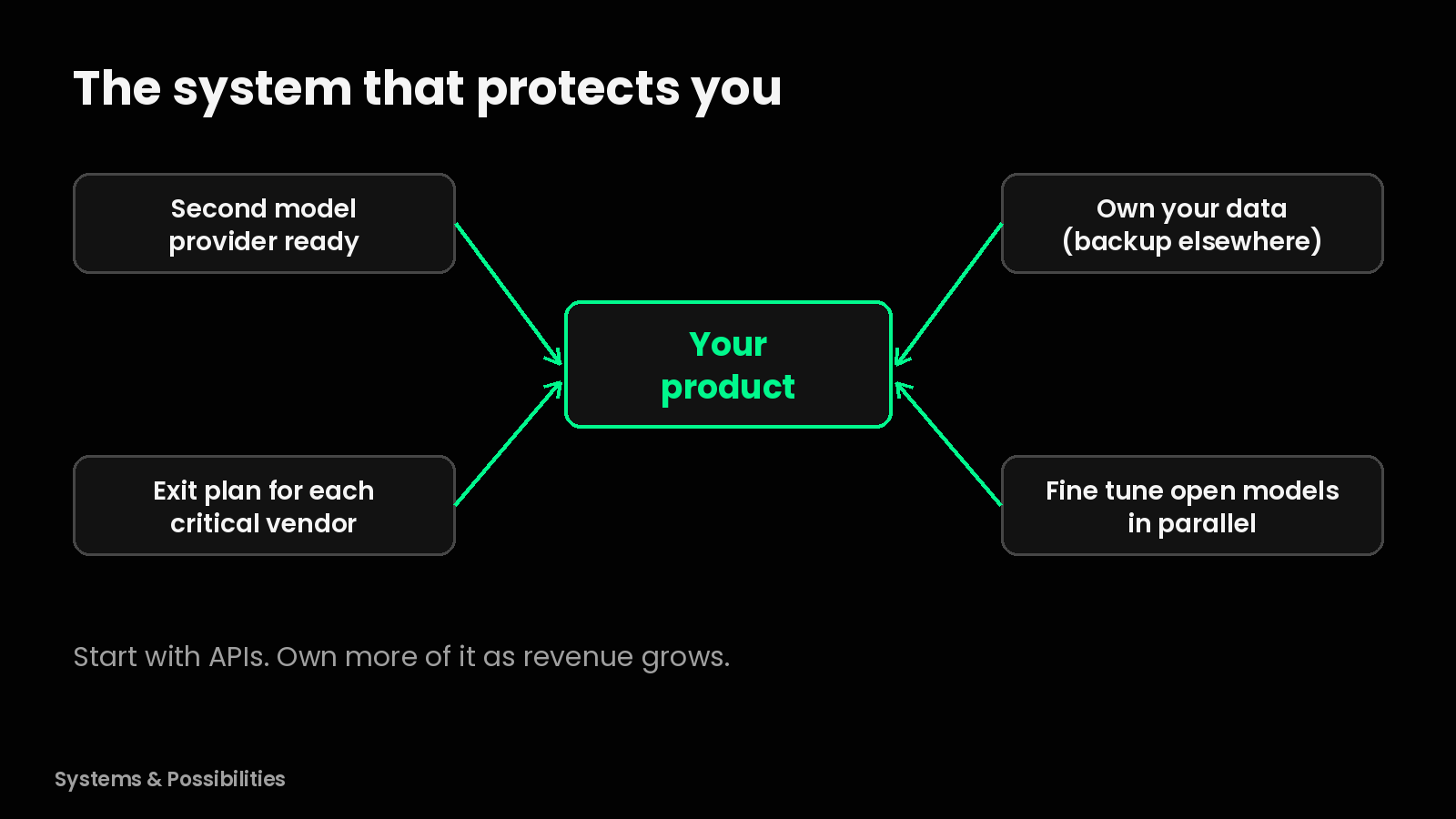
The system I'd build around any product that sits on a lab.
Of those, the one thing I would never let a single vendor hold is data. I would want a backup with a different vendor. Even for all the other stuff, always have backups and try to make the architecture model and provider agnostic. It will help in the long run.
In plain words, that means building the product so you can swap the AI model, or the company behind it, without starting over.
The same goes for the model itself. If I were building on a lab's API today, I would start fine tuning open source models in parallel to match frontier performance. It's expensive at the start, so we can start with APIs, but always keep striving to own your models as you start having sufficient revenue.
For non-coders, an API is how your product rents a lab's model. Fine tuning an open source model means training a free model you control on your own data, so one day you own it instead of renting it.
Will it still matter in six months?
Yes. Orchestra and Chroma are just this week's examples. In six months the labs will ship more of what startups sell today, and more small vendors will get bought or shut down as the market settles. The deals will change. The risk won't.
What it makes possible
If the labs can copy any feature, the space left for startups is the work they won't bother with. Find the boring and harder work rather than the easy. Working on that will always pay off in the end.
And speed alone won't save you. Being first is not the moat anymore, because the product can be replicated in no time. What matters is distribution. Understanding what the customer wants is the harder part, and the person who owns it becomes harder to replace. We should all try to be the Snapchat in the domain we are working in.
So what's one thing in your product you'd never let a single vendor hold? Leave a comment, I'd like to hear it.
Sources
- OpenAI acquires Orchestra Bio, 20 Oct 2026: https://openai.com/index/openai-to-acquire-orchestra-bio/
- TechCrunch, 20 Oct 2026: https://techcrunch.com/2026/10/20/openai-acquires-startup-orchestra-bio%e2%81%a0-to-beef-up-its-biotech-business/
- Chroma is joining Replit, 23 Oct 2026: https://www.trychroma.com/blog/chroma-joins-replit
- Chroma Cloud wind-down: https://www.trychroma.com/cloud-wind-down
- Sacra, RIP AI Slides 2022-2026: https://sacra.com/research/rip-ai-slides-2022-2026/
- The Guardian on "Sherlocked", 2013: https://www.theguardian.com/technology/2013/oct/28/sherlocked-how-mavericks-is-making-some-apps-obsolete