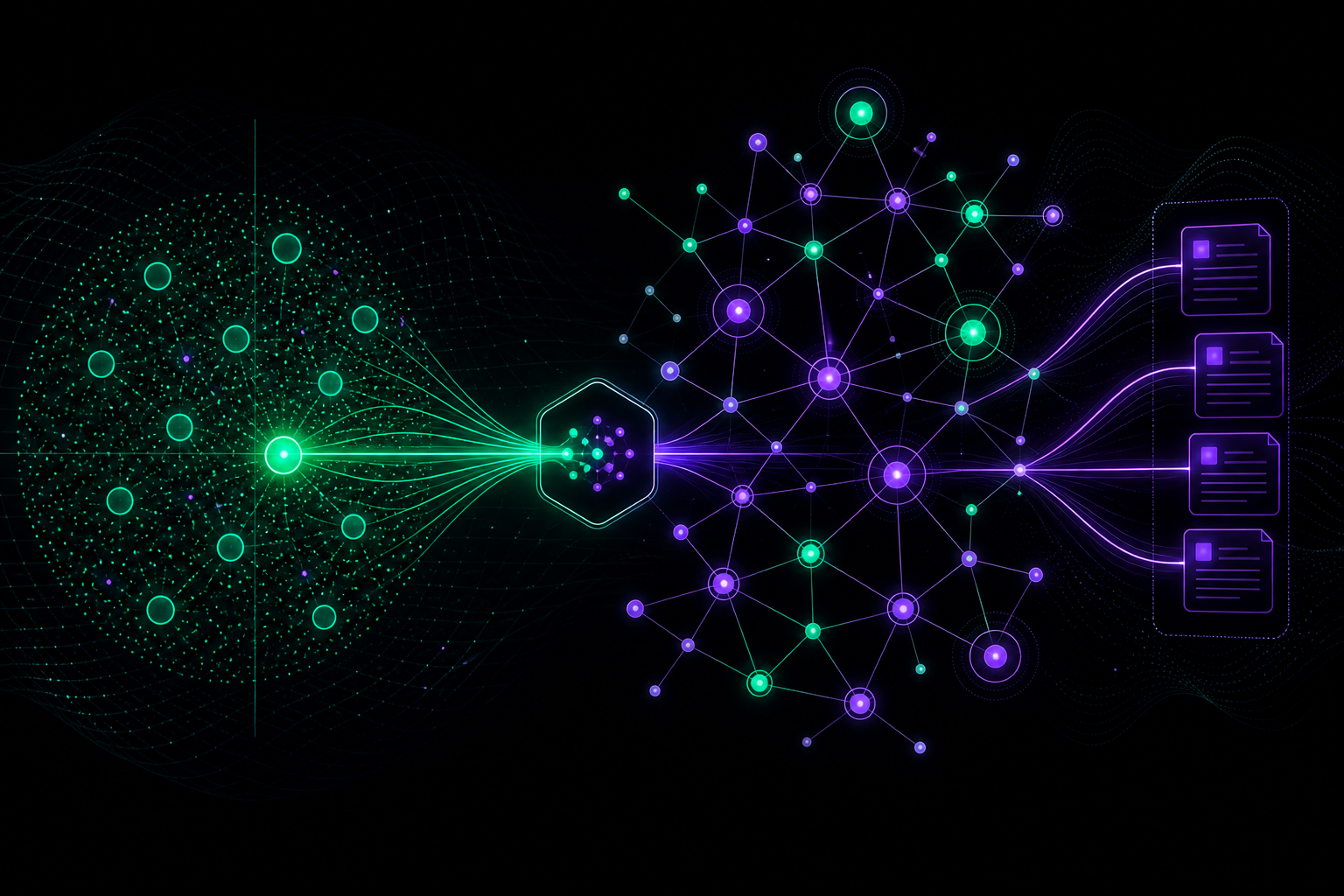
RAG is no longer experimental. Adoption studies such as Enterprise AI Adoption Trends 2026 put retrieval-augmented generation among the dominant patterns for enterprise knowledge apps. The next question is not "should we use RAG?" It is "what kind of retrieval architecture will survive messy corporate data?"
Naive "embed everything and cosine search" systems still demos well. They also fail on IDs, policy clauses, entity relationships, and questions that need multi-hop reasoning. That is where hybrid retrieval and graph structure earn their keep.
Where Pure Vector RAG Breaks
- Exact identifiers: invoice numbers, SKUs, contract clause IDs
- Keyword-heavy policy language where rare terms matter
- Questions that need relationships: who owns X, what depends on Y
- Conflicting versions of the same document across systems
Embeddings are great at semantic similarity. They are not a substitute for lexical precision or explicit structure.
Hybrid Search as the Default Baseline
Hybrid search combines dense vector retrieval with sparse or keyword retrieval (BM25 or similar), then fuses ranks. In production systems I have shipped, hybrid almost always beats vectors alone on enterprise corpora.
A practical baseline:
- Chunk with structure awareness (headings, tables, section titles)
- Store dense embeddings plus a lexical index
- Retrieve from both, fuse with reciprocal rank fusion or weighted scoring
- Optionally rerank with a cross-encoder for the top candidates
This is still "RAG." It is just RAG that respects how enterprise documents actually work.
Key Takeaway
If your first production RAG only uses vectors, add hybrid search before you add agents, fancy memory, or a second LLM provider.
When Knowledge Graphs Help
Graphs shine when relationships are the product:
- Org structures and ownership
- Product, part, and dependency maps
- Investor-startup or customer-account networks
- Career transitions and role adjacency
I have used graph-based matching in investor recommender and career-pathing systems. The graph is not a buzzword layer. It encodes edges that embeddings approximate poorly.
Graph-aware RAG patterns
- Entity-linked retrieval: extract entities, expand to related nodes, then fetch supporting text
- Community or neighborhood summaries: precompute summaries for clusters, retrieve those for broad questions
- Constraint filters: use graph properties to hard-filter candidates before generation
Approaches often labeled GraphRAG are useful when users ask relational questions. They are overkill for simple FAQ bots over a small handbook.
Choosing the Right Architecture
Start with hybrid RAG if...
- Your corpus is mostly documents and tickets
- Questions are "what does policy say" or "summarize this topic"
- You need a first production system in weeks, not months
Add a graph layer if...
- Users repeatedly ask relationship or multi-hop questions
- You already maintain structured entity data
- Filtering by relationship cuts hallucination risk more than bigger context windows
Keep classical search or SQL if...
- The question is an exact lookup against a database of record
- An LLM wrapper only adds latency and uncertainty
Evaluation Still Decides
Architecture debates get religious fast. End them with numbers:
- Retrieval recall on a labeled question set
- Answer groundedness
- Latency and cost per successful answer
- Failure rate on ID and relationship questions
I have seen hybrid retrieval lift relevance enough that a mid-size generator outperforms a larger model on vector-only context. Retrieval quality compounds.
Better context beats a bigger model more often than teams expect.
Implementation Notes From Production
- Preserve metadata: source, section, updated_at, ACL tags
- Version your index the same way you version code
- Separate ingest quality from generation quality in dashboards
- Do not dump entire graphs into prompts; retrieve neighborhoods on demand
- Cache frequent queries and embedding results where traffic repeats
How This Fits the 2026 Enterprise Stack
As GenAI becomes infrastructure, knowledge systems need the same discipline as search platforms. Hybrid retrieval is table stakes. Graphs are a strategic layer when your domain is relational. Agents and multi-model routing sit on top, but they cannot fix bad context.
If you are still stuck on a vector-only pilot, upgrade the retrieval layer before you redesign the UI.
Bottom Line
In 2026, serious RAG is hybrid by default and graph-aware when relationships matter. Pick the architecture based on question types and evaluation results, not on whatever paper was popular last month.