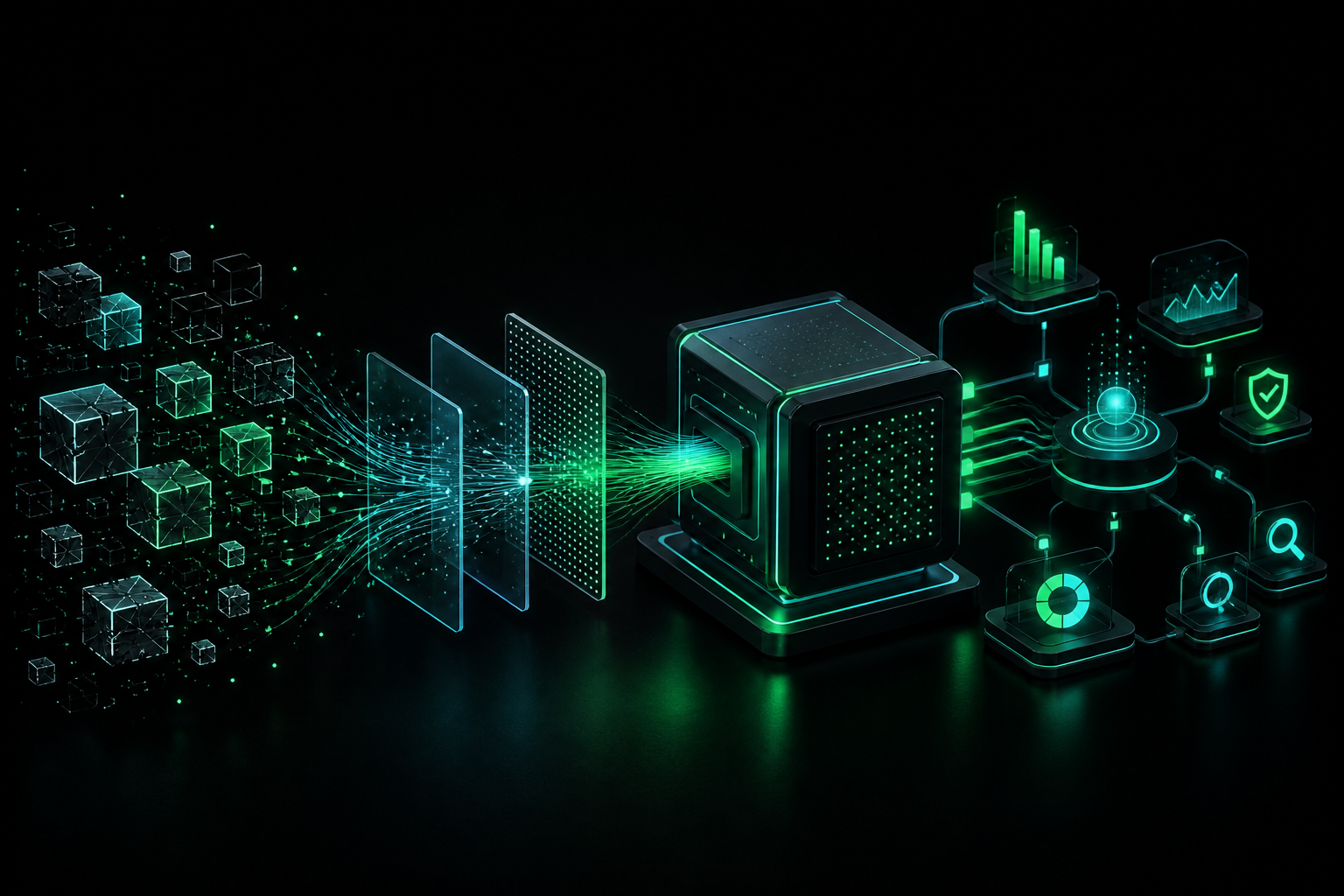
According to analysis cited in the Kearney AI Trends Report 2026, roughly 46% of AI proof-of-concepts were scrapped before deployment last year. That is not a tooling problem. It is an architecture and operating-model problem.
Teams can spin up a chatbot demo in a week. Getting that same idea into a governed, monitored, cost-controlled production system is a different job. In 2026, the gap between ambition and execution is where most enterprise AI budgets quietly disappear.
I have spent years shipping production AI across startups and enterprises. The pattern is consistent: PoCs fail when they prove the model can answer a question, not when they prove the system can survive real traffic, bad data, and audit requirements.
What a PoC Actually Proves
A typical PoC answers one question: can an LLM or model produce useful output on a curated sample?
- Happy-path prompts only
- Clean documents, often hand-picked
- No latency budget under load
- No clear owner for failures at 2 a.m.
- No path for permissions, PII, or retention rules
That is useful discovery work. It is not a production readiness test. Treating it as one is how you get a slide deck that never becomes a service.
The Production Gap in 2026
Enterprise GenAI has matured. Research summarized in Enterprise AI Adoption Trends 2026 puts a large share of organizations with at least one GenAI app in production, and RAG as a common pattern for knowledge work. Adoption is rising. So is the bar for what "done" means.
Meanwhile, agentic and multi-step systems are expanding use cases. Reports like Anthropic's 2026 State of AI Agents show organizations moving from single tasks toward multi-stage workflows. Complexity rises faster than demo quality.
Key Takeaway
If your PoC only measures answer quality on a demo set, you have not measured production risk. Measure data readiness, evaluation, cost, and ownership before you call it a win.
Five Pillars That Separate Demos From Systems
Kearney frames scaled value around integrated "decision fabrics": data, models, orchestration, LLM ops, and an operating model. In practice, I use a similar checklist with clients.
1. Data plane
Production systems need lineage, access control, and refresh pipelines. If retrieval depends on a one-off folder of PDFs, the answer quality decays the day someone updates SharePoint without telling you.
2. Model plane
Pick models for the job. Many teams now run more than one LLM family and mix RAG with classical ML where it fits. One frontier model for everything is rarely the cheapest or safest design.
3. Orchestration
Multi-step flows need plan, act, check, and recover loops. Human approval on high-risk actions is not a compromise. It is how you ship agents that finance and legal will accept.
4. Evaluation and LLMOps
You need offline evals before release and online telemetry after. Track groundedness, task success, latency, and cost per successful outcome. Without that, you are optimizing vibes.
5. Operating model
Someone owns intake, prioritization, release criteria, and incident response. Without an "AI office" or clear product owner, every PoC becomes an orphaned experiment.
A Practical Gate Before Production
Before promoting a PoC, force a written answer to these questions:
- What is the business KPI, and how will we measure it weekly?
- What data sources are authoritative, and who maintains them?
- What fails closed when the model is wrong?
- What is the max acceptable cost per successful task?
- Who is on call when retrieval or tools break?
If any answer is vague, keep it in discovery. Do not put it behind a customer login.
How I Approach Architecture Reviews
When teams ask me to take a PoC to production, we usually do three things first:
- Redraw the system around data contracts and failure modes, not prompt screenshots.
- Define an evaluation set that matches real user traffic, including edge cases.
- Choose the thinnest architecture that can meet latency, privacy, and audit constraints.
Sometimes that means a simple RAG service with hybrid search. Sometimes it means a classifier plus rules with an LLM only at the edge. Production is about fit, not novelty.
Ship the smallest system that earns trust under real constraints. Expand after the metrics hold.
What Good Looks Like in 2026
Winning teams treat GenAI like infrastructure:
- Versioned prompts, indexes, and model configs
- CI checks for eval regressions
- Dashboards for quality, cost, and latency
- Clear rollback paths
- Security review before broad rollout
That sounds heavier than a weekend prototype. It is also why those systems still exist six months later.
Bottom Line
PoCs are cheap. Production is a product. If nearly half of AI experiments never ship, the opportunity is not "better demos." It is better architecture, clearer ownership, and evaluation that matches reality.
If you have a promising PoC stuck in limbo, start with the five pillars above. Fix the weakest one first. That is usually where the project is actually blocked.